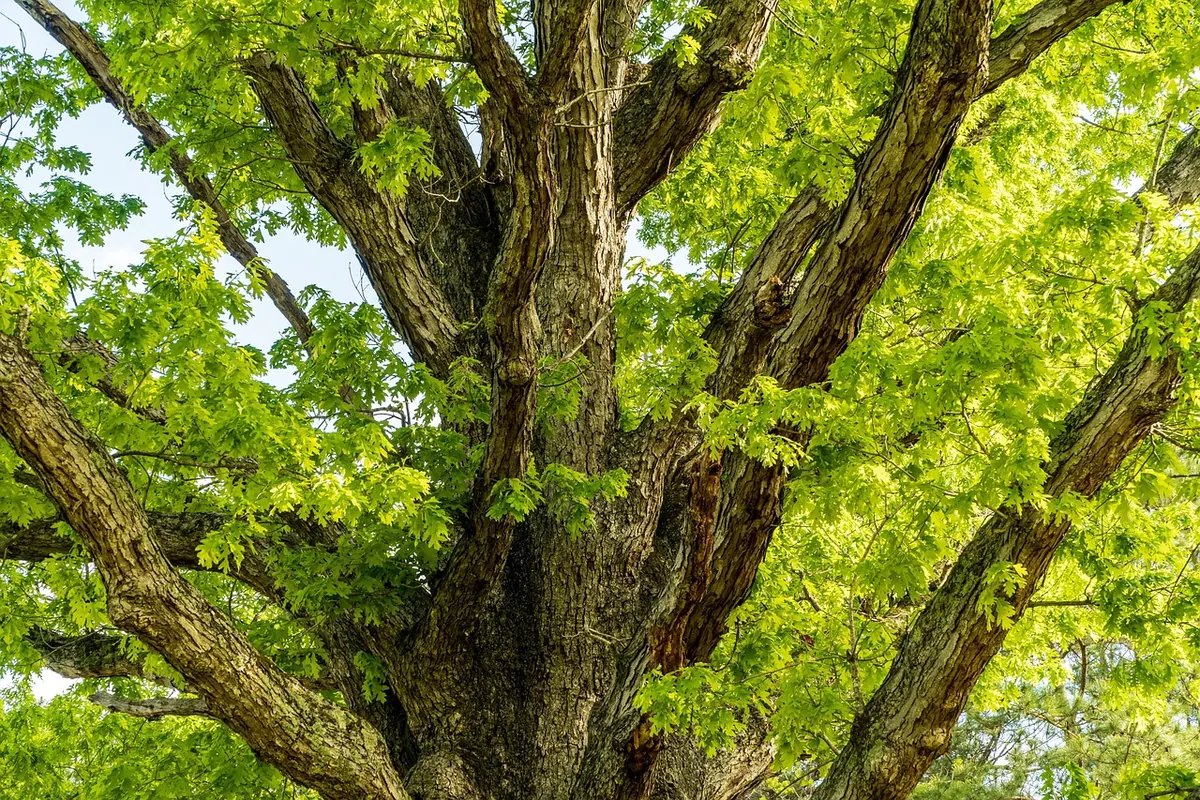
Walk almost anywhere in Britain and you are within sight of a tree somebody once thought twice about felling. The oak, the ash and the hawthorn have been folded into our superstitions, medicines and stories for centuries — sometimes as protectors, sometimes as warnings. Once you know what people believed about them, a hedgerow stops being scenery. A lone thorn becomes a meeting place, an ash sapling a doorway, an oak a small parliament of thunder-gods, kings and village children.
These three turn up in tree lore more than any others, and the reason is mostly practical. They were common, useful and long-lived. The oak gave the strongest timber. The ash gave handles, oars and cart shafts. The hawthorn gave a thorny, stock-proof hedge that grew quickly and could be laid by hand. Familiar things collect stories. A tree you pass every day, that outlives your grandparents and marks a boundary or a crossroads, gathers meaning the way an old gate gathers lichen.
One caution before we go further. Tree lore is local and often contradictory. What was lucky in one county was unlucky in the next, and the same tree could be a protector in a charm and a warning in a rhyme. Treat what follows as a map of beliefs, not as a single rulebook handed down intact.
The oak was king of the wood long before anyone wrote it down, and it is the tree most often linked with thunder. Norse tradition gave it to Thor. Closer to home, a rhyme remembered in the countryside turned that association into blunt advice:
Beware the oak, it draws the stroke;
Avoid the ash, it courts the flash;
Creep under the thorn, it will save you from harm.
It is a lovely piece of folklore and poor safety advice. In a real thunderstorm, none of the three is a safe place to shelter; get indoors or into a hard-topped vehicle instead.
Royalty followed the thunder. After the Battle of Worcester in 1651, Charles II hid in an oak at Boscobel while soldiers searched beneath it, and the tree became a political talisman. Oak Apple Day on 29 May was kept with sprigs of oak worn in hats, and some parishes decorated the church with oak leaves. The name has nothing to do with fruit: an oak apple is a round gall made by a wasp, and galls like these were once dried, pierced and carried as charms. They were also the basis of iron gall ink, which is why the oldest parish registers still look brown rather than black.
Oak bark was stripped for tanning leather, and the same tannins made it a folk astringent — a gargle for sore throats, a wash for weeping skin. Herbalists still work with it in small doses, but that is not instruction. Strong tannin preparations can irritate, and anything you plan to take internally is worth checking with a pharmacist or doctor first. In the meantime, an acorn in the pocket was said to keep a man young, and a lone oak in a field was often left standing as a boundary mark for the parish.
The ash was a world tree before it was a hedgerow tree. In Norse myth, Yggdrasil is an ash whose roots and branches hold the nine worlds together, and something of that vast, world-holding reputation clings to the ash in British tradition.
The best-known ash custom is also the strangest. A young ash was split lengthways, and a sick child — usually one with rickets, a rupture or a persistent cough — was passed through the gap at dawn, sometimes three times, sometimes nine, while those helping said nothing at all. The trunk was then bound back together. If the two halves grew as one, the child was said to mend; if the tree died, the cure had failed. Versions of this ritual were recorded across many English counties.
A cousin of that practice was the shrew ash. A hole was bored into the trunk, a shrew was placed inside, and the hole was plugged. Livestock and aching limbs were then stroked against the tree to draw out the ailment. It is a grim, practical-sounding piece of magic, and it shows how often folk medicine treated the tree as a living instrument rather than a symbol.
If the ash came into leaf before the oak, the old rule said, expect a wet summer; if the oak came first, expect a drier one. The rhyme changes from county to county and the forecasting is beside the point — what mattered was that it gave a farmer a reason to watch two trees at once. Ash bends without breaking, which is why it became the wood for tool handles, oars and hurleys, and why the saying went that ash burned green or dry would warm a king's slippers. The bunches of seeds, called keys, were hung in doorways for protection, and children knew them as spinners for the way they whirl down in autumn. Ash dieback has stripped many hedgerows of the tree in recent years, which makes the old stories worth writing down.
The hawthorn is the tree of May, and the one with the sharpest rules attached. Its blossom arrives around Beltane, the start of the year's light half, and May Day customs — garlands, boughs, a girl dressed in white — were built around it. Yet the same blossom was often forbidden indoors. Bringing hawthorn into the house was said to invite illness or death, and the scent, which carries a faint note of decay, probably explains why people found it unsettling.
A hawthorn standing alone in a field or at a crossroads was a fairy tree, and cutting one was risky. Stories persist of roads and building schemes being routed around a stubborn thorn, whether out of belief or simply because the paperwork that comes with an old boundary tree is not worth the argument. Either way, the lore kept the tree standing, and the tree gave shade to cattle and a landmark to anyone walking home in the dark.
At wells and holy thorns, visitors tied strips of cloth — clooties — to the branches, each rag carrying a wish or an illness to be left behind. The custom survives, particularly in Scotland, Ireland and the west of Britain. If you join in, use something that will rot away and never break a branch to tie it on.
The most famous hawthorn in the country grew at Glastonbury. Legend says Joseph of Arimathea pushed his staff into Wearyall Hill and it flowered, and the thorn that resulted was said to blossom at Christmas. Cuttings were planted widely, and a hawthorn that flowers in midwinter is still pointed out as a descendant. Hawthorn berries and flowers also have a long history in Western herbal medicine as a heart tonic. Because hawthorn can interact with heart medication, anyone considering it — especially anyone with a heart condition or taking digoxin, beta-blockers or blood thinners — should speak to a doctor or pharmacist first and let them make the call.
Folklore survives by being used, and the uses are small. Learn to tell these three apart in winter, when only the buds and bark are on show, and the landscape starts to talk back. Walk the same lane in February, May and October and you will watch a year turn on them.
A few things worth doing:
And a sensible word on the medicine. Almost everything here is recorded belief rather than clinical guidance. If you want to try any plant remedy mentioned above, speak to a qualified herbalist or your GP first, particularly where the heart is concerned.
Photo: 16081684 / Pixabay